5 Government Skill Development Schemes Every Rural Youth Should Know in 2026
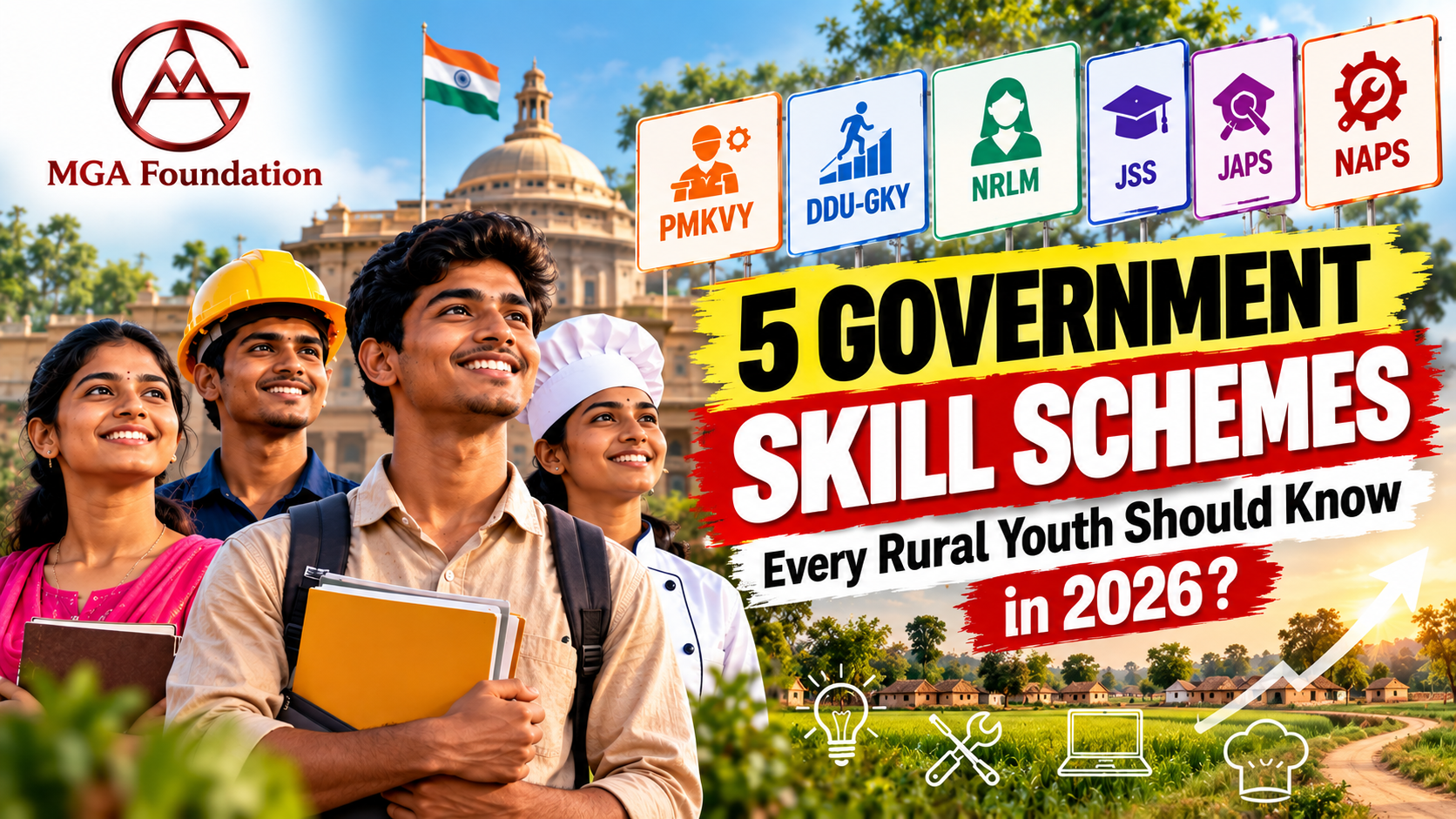
Every year, thousands of capable young people from rural India miss out on free government training simply because nobody explained the paperwork to them in plain language.
Ask any parent in a small town or village what worries them most about their child's future, and the answer is almost always the same: a good, stable job. What most families do not realise is that the Indian government already runs several large scale schemes designed to give young people exactly that, free vocational training, certified skills, and direct placement support. The problem is not a lack of opportunity. It is a lack of awareness. During our employment counselling sessions and career guidance workshops, we consistently meet bright, motivated youth who have never even heard of these programs. This guide breaks down five of the most impactful schemes, in plain language, so you can decide which one fits your situation.
1. Pradhan Mantri Kaushal Vikas Yojana (PMKVY)
PMKVY is the flagship skill training scheme run by the Ministry of Skill Development and Entrepreneurship. It offers short term training, ranging from a few weeks to a few months, in trades like electrician work, beauty and wellness, retail, and IT support. Training is completely free, and candidates who clear the final assessment receive a government certified credential recognised by employers across the country. You can check active batches and enrolment centres near you on pmkvyofficial.org.
What makes PMKVY genuinely useful is the Recognition of Prior Learning component. If you already have informal skills, say you have been fixing motorcycles in your village for years without a formal certificate, PMKVY can test and certify what you already know, instantly making you eligible for better paying, organised sector jobs.
2. Deen Dayal Upadhyaya Grameen Kaushalya Yojana (DDU-GKY)
DDU-GKY is specifically built for rural youth between the ages of 15 and 35 from poor households. Unlike some schemes that stop at training, DDU-GKY guarantees placement assistance for at least 70 percent of trained candidates, and often includes post placement support to help candidates settle into a new city or role. It covers everything from hospitality and healthcare to manufacturing and logistics.
The residential training model is one of its strongest features. Many centres provide free boarding and lodging during the course, which removes one of the biggest barriers rural candidates face: the cost of relocating to a training hub before they have even earned a single rupee.
3. National Rural Livelihood Mission (NRLM)
NRLM works through Self Help Groups and is particularly powerful for women looking to build sustainable, self employed livelihoods rather than salaried jobs. It combines skill training with access to low interest credit, market linkages, and mentorship, which is precisely the gap we address through our own women empowerment programs.
If your goal is to start a small business rather than find a job elsewhere, NRLM is often the better starting point compared to purely job oriented schemes, because it treats entrepreneurship as a legitimate, supported career path rather than an afterthought.
4. Jan Shikshan Sansthan (JSS) Scheme
JSS centres exist in many districts specifically to serve non literate, neo literate, and school dropouts, groups that often cannot access mainstream training programs because of eligibility criteria tied to formal education. Courses are typically short, practical, and locally relevant, think tailoring, mobile repair, or food processing, based on what actually employs people in that specific district.
5. National Apprenticeship Promotion Scheme (NAPS)
NAPS is a different kind of opportunity altogether. Instead of classroom training followed by a job search, it places you directly inside a company as an apprentice, earning a stipend while you learn on the job. For a fresher with no work experience, twelve months as an apprentice at a real company often opens more doors than a certificate alone ever could. Details on registered establishments and stipend rates are available through the Ministry of Skill Development at msde.gov.in.
Why So Many Eligible Youth Never Apply
In our field experience, the drop off is rarely about interest. It comes down to three recurring issues: candidates do not know a scheme exists, the application process feels intimidating without guidance, or the nearest training centre is too far to reach without local support. This is exactly the gap NGOs are meant to close, connecting the scheme on paper to the person who actually needs it, and walking with them through the form filling, document verification, and travel logistics that a government portal alone cannot solve.
How to Choose the Right Scheme for You
Ask yourself one simple question first: do you want a job, or do you want to build your own income? If you are looking for salaried employment, PMKVY and DDU-GKY are your strongest starting points. If you already have an informal skill you want certified, PMKVY's Recognition of Prior Learning route saves you time. If entrepreneurship excites you more than a monthly salary, NRLM will serve you far better in the long run.
Documents You Will Typically Need
Most of these schemes ask for a similar base set of documents, so it helps to prepare them in advance rather than scrambling at the enrolment centre. Keep your Aadhaar card, a recent passport sized photograph, proof of residence, your highest qualification certificate, and a bank passbook with an active account ready. Candidates from Scheduled Caste, Scheduled Tribe, OBC, or BPL backgrounds should also carry the relevant category certificate, since several schemes reserve additional seats or benefits for these groups.
| What You Need | How MGA Foundation Helps | Link |
|---|---|---|
| Understanding which scheme fits your goals | One on one career counselling to match your background and interests to the right program | Education Program |
| Building an employable skill from scratch | Hands on vocational and soft skills training alongside scheme enrolment | Livelihood Program |
| Support for women choosing self employment | Mentorship, credit linkage guidance, and market access support | Women Empowerment |
| Helping us reach more rural youth like you | Every contribution funds outreach, transport, and training materials for candidates who cannot afford them | Donate |
A Word of Caution on Middlemen
Every government scheme listed here is free to apply for. If anyone, an agent, a so called consultant, or even someone claiming to represent a training centre, asks you for money to "guarantee" a seat or a certificate, walk away immediately. Genuine skill development schemes never charge candidates a registration or placement fee.
What Happens After Training Ends
Completing a course is only half the journey. The real test is what happens in the weeks after, updating your resume with the new certification, practising for interviews, and following up with placement cells instead of waiting passively for a call. Many of the same principles we cover in our piece on building sustainable income apply here too: a certificate opens the door, but consistent follow up is what gets you through it.
I did not know the government would train me for free until someone from MGA Foundation sat with my family and explained the whole process. Six months later, I had a certificate and a job offer in the same week.
Frequently Asked Questions
Are these government skill development schemes really free?
Yes. PMKVY, DDU-GKY, NRLM, JSS, and NAPS do not charge candidates any registration, training, or certification fee. Some schemes, like DDU-GKY, even provide free food and stay during residential training.
What is the minimum age to apply for PMKVY?
Most PMKVY trades accept candidates from age 18, though some short duration courses accept applicants from age 15 onward depending on the trade and training partner.
Can school dropouts apply for these schemes?
Yes, several schemes are designed specifically for school dropouts and non literate candidates, particularly the Jan Shikshan Sansthan program, which does not require a formal educational qualification.
Is a stipend paid during training?
Apprenticeship based programs like NAPS pay a monthly stipend since you work at a company while learning. Classroom based schemes like PMKVY generally do not pay a stipend, though some state variants offer a small daily travel allowance.
How long does a typical training program take?
It varies widely by trade, from a few weeks for short certificate courses to twelve months for full apprenticeships under NAPS. Most PMKVY courses fall between one and three months.
Do I need to know English to enrol?
No. Training under most government schemes is conducted in the local or regional language, and assessments are typically available in multiple Indian languages.
What if I do not have all the required documents yet?
Reach out to a local support organisation before you give up. Missing documents like caste certificates or residence proof can usually be arranged through the local municipal or panchayat office, and counsellors can guide you through this step by step.
How does MGA Foundation fit into all this?
We do not run these government schemes ourselves, but we help candidates identify the right one, prepare documents, complete applications, and build the practical and soft skills that make the difference between finishing a course and actually landing a job afterward.
If you or someone you know is trying to figure out where to start, do not let paperwork be the reason a good opportunity slips by. Reach out to our team through the contact page and we will help you find the scheme that actually fits your situation.