How to Donate to an NGO: 7 Things You Should Check Before Giving Money
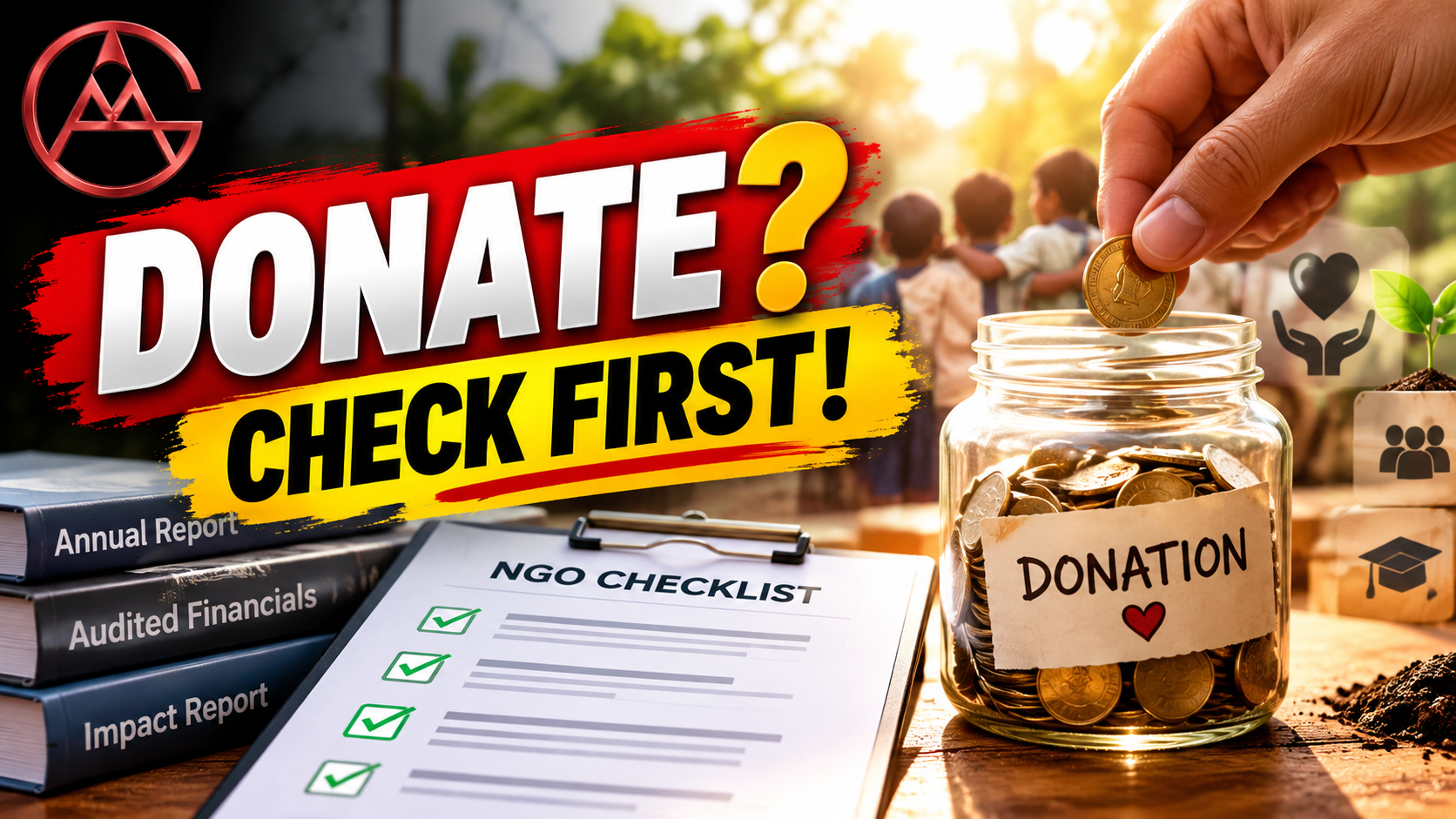
A good cause does not automatically mean a good organisation. The two are not the same thing, and confusing them is how well meaning donors end up funding the wrong people.
Most people decide to donate with their heart first, after seeing a moving photo, a relative's appeal, or a stranger's story online. That instinct is not a problem. The problem is stopping there. India has thousands of registered nonprofits, and unfortunately also a fair number of organisations that exist mainly on paper. Before your money leaves your account, a few minutes of checking can tell you whether it is going toward real work or disappearing into an opaque system. We get asked about this constantly, often by the same people who have already read our piece on government skill development schemes and want to know how to extend that same scrutiny to charitable giving. Here are the seven checks worth doing every single time.
1. Confirm the NGO Is Actually Registered
Every legitimate nonprofit in India is registered under one of three structures: a Trust, a Society, or a Section 8 Company. Ask for the registration number and certificate, and do not feel awkward about it, any genuine organisation will produce this without hesitation. If the NGO claims to work on CSR funded projects, you can also cross check its listing on the Ministry of Corporate Affairs portal at mca.gov.in.
Registration alone does not guarantee good work, but its absence is an immediate red flag. An organisation that cannot show you a certificate is not an NGO you should be writing a cheque to, no matter how convincing the person asking happens to be.
2. Check Whether Your Donation Is Tax Exempt
If an organisation is genuinely doing charitable work and following proper financial procedure, it will usually hold valid 80G and 12A certification from the Income Tax Department, which allows you to claim a tax deduction on your donation. You can verify an organisation's current registration status directly on the incometax.gov.in portal under the exempted institutions search.
A missing 80G certificate does not automatically mean the NGO is fraudulent, some very young or very small grassroots groups have not completed the paperwork yet, but it does mean you should ask more questions before giving a large amount.
3. Look at How Old the Organisation Actually Is
Longevity is not proof of quality, but it does tell you something. An NGO that has operated consistently for five, ten, or twenty years has survived audits, renewed its certifications multiple times, and built a track record that can be checked against. A six month old organisation asking for large donations deserves a closer look, not automatic rejection, just more homework on your part before you commit.
4. Ask to See the Annual Report and Audited Financials
If an organisation cannot tell you, in plain numbers, how much it raised last year and where that money went, that is the single biggest warning sign of all. A transparent NGO publishes its audited financial statements, usually on its own website or on request, showing income, program expenses, and administrative costs broken down clearly.
Pay attention to the ratio between program spending and administrative or fundraising costs. There is no single universal benchmark, program models vary, but an organisation spending the overwhelming majority of its budget on salaries, travel, and overhead while very little reaches actual beneficiaries is worth questioning directly.

5. Verify the Work on the Ground, Not Just on the Website
Glossy websites and professional photography are easy to produce and say very little about actual impact. Look for specifics instead: named locations, measurable outcomes, dates, and ideally some form of third party documentation, a news mention, a government partnership letter, or a corporate CSR report that references the same project. Our own stories page is a good example of the kind of concrete, dated, named detail a legitimate NGO should be able to show you.
6. Understand Exactly What Your Money Will Fund
Vague appeals like "help us help more children" sound warm but tell you nothing. A credible NGO can explain precisely what a specific donation amount achieves, whether that is funding one month of vocational training for one candidate, covering school supplies for a fixed number of students, or sponsoring a defined community health camp. Specificity is a sign of an organisation that actually tracks its own spending, not just one that is good at marketing.
7. Check How the Organisation Handles Follow Up
What happens after you donate matters almost as much as the donation itself. Does the NGO send a receipt promptly? Does it ever update donors on outcomes, or does communication go silent the moment the payment clears? Organisations genuinely accountable to their donors tend to over communicate, not under communicate, because transparency is part of how they retain support over the long term.
Red Flags That Should Make You Pause
A few patterns come up again and again with organisations that turn out to be unreliable or outright fraudulent: pressure to donate immediately with no time to verify anything, requests for cash only with no digital trail, an unwillingness to provide a registration number when asked directly, and claims of impact so large they would require a budget many times bigger than what the organisation can plausibly show. None of these alone is definitive proof of fraud, but two or three together is reason enough to walk away.
Small Donations Deserve Scrutiny Too
It is tempting to skip all of this for a modest contribution, telling yourself the amount is too small to matter. But scale is exactly how fraudulent collection schemes work, a thousand small, unverified donations add up to a very large, largely untraceable sum. The checklist above takes the same five minutes whether you are giving five hundred rupees or five lakh, so there is no real reason to skip it for smaller gifts.
Where to Verify Charity Registration Independently
Beyond asking the organisation directly, India's ngodarpan.gov.in portal, maintained by NITI Aayog, lists registered voluntary organisations along with their unique registration identity. It is a useful independent cross check that does not rely on the NGO's own self reported claims.
| What You Want to Know | How MGA Foundation Shows It | Link |
|---|---|---|
| Who we are and what we actually run | A clear breakdown of our ongoing programs across education, livelihood, and community development | About Us |
| Proof our programs create real outcomes | Named, dated stories from people our training and support programs have directly helped | Impact Stories |
| Exactly where a specific donation goes | A donation page that lets you choose the program your contribution supports | Donate Page |
| A direct answer to any question before you give | A real team you can reach and ask about registration, finances, or ongoing work | Contact Us |
A Simple Rule of Thumb
If an organisation makes you feel guilty for asking questions, that reaction alone tells you something important. A nonprofit confident in its own integrity welcomes scrutiny because it has nothing to hide. One that deflects, rushes you, or treats basic due diligence as an insult is giving you useful information, even if it is not the information it intended to share.
I used to donate to whichever appeal reached me first. Now I spend ten minutes checking registration and financials before I give anything, and honestly, it has made me trust my own giving far more.
Frequently Asked Questions
How can I check if an NGO is registered in India?
Ask the NGO directly for its registration certificate and number, then cross verify it on the ngodarpan.gov.in portal maintained by NITI Aayog, which lists registered voluntary organisations across the country.
Is my donation to an NGO tax deductible?
It can be, provided the NGO holds a valid 80G certificate from the Income Tax Department. You can confirm current certification status on the official income tax portal before donating if you plan to claim the deduction.
What documents should a genuine NGO be able to show me?
At minimum, a registration certificate (Trust, Society, or Section 8 Company), PAN details, and audited financial statements for recent years. Most established NGOs can also share 80G and 12A certificates.
How much of my donation should actually reach beneficiaries?
There is no single fixed percentage that applies to every program model, but a transparent NGO will clearly explain its cost structure and justify its administrative spending rather than avoid the question entirely.
Should I donate in cash or digitally?
Digital payments are strongly preferable since they create a traceable record and usually generate an automatic receipt, which also makes claiming a tax deduction much simpler later.
Are small, one time donations worth checking too?
Yes. Fraudulent collection schemes often rely on volume rather than size, so the same quick verification is worth doing regardless of how much you plan to give.
What if an NGO cannot answer my questions clearly?
Treat hesitation or vague answers as useful information. A credible organisation welcomes questions about registration, finances, and impact because transparency is part of how it builds long term donor trust.
Does a well designed website mean an NGO is trustworthy?
Not on its own. A professional website is easy to produce regardless of actual program quality, so always look past the design for registration numbers, named outcomes, and audited financials.
Have questions about our registration, our finances, or exactly where your contribution would go? Reach out through our contact page and our team will walk you through it directly, before you give a single rupee.